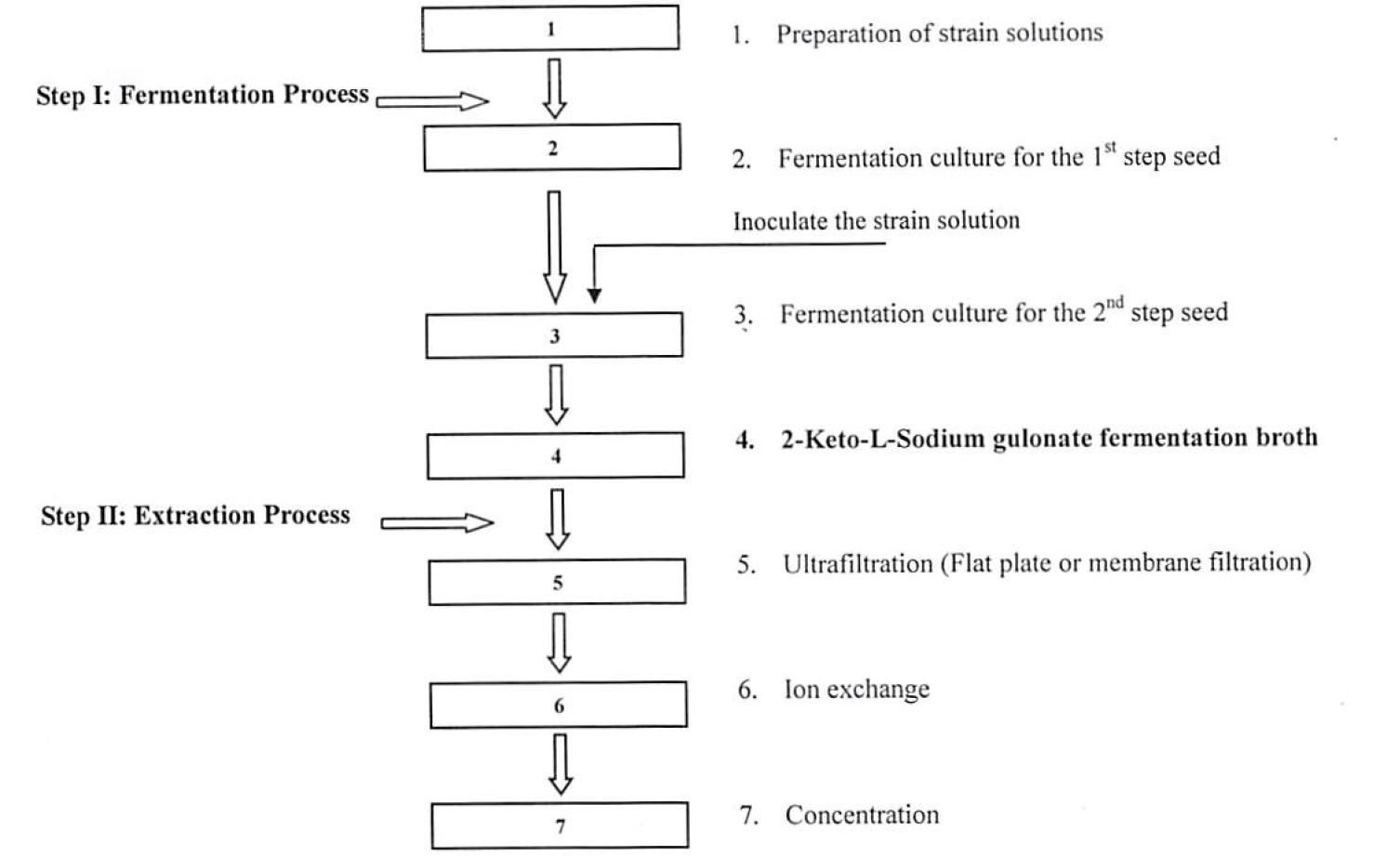
Today industrial production processes use additional bio-oxidation steps with Ketogulonicigenium vulgare as biocatalyst to convert D-sorbitol to the intermediate 2KGA without chemical steps. The major end-user industries of ascorbic acid are pharmaceuticals food beverages personal care and others.

Vitamin C Biosynthesis Learn Science At Scitable
The dried edible portions of fruits and vegetables are ground to a fine.
Ascorbic acid manufacturing process. The crude ascorbic acid is filtered purified and milled into a fine crystalline powder. Abstract PROCESS FOR PREPARATIN OF VITAMIN-C The synthesis of ascorbic acid was achieved by Reichstein in 1933 followed by industrial production of ascorbic acid two years later by Roche. The present invention relates to a novel process for the production of L-ascorbic acid in high yields by using resting cells of a microorganism able to convert given carbon sources into vitamin C.
The synthesis of L-ascorbic acid developed in 1934 by Reichstein and Grussner has remained a cornerstone for the commercial production of vitamin C. The ultimate raw material for the production of vitamin C ascorbic acid is corn or wheat. Even more disturbing ascorbic acid is frequently marketed as natural vitamin C and added to organic foods as a natural preservative.
Vitamin C helps to recycle vitamin E. L-Ascorbic Acid Manufacturing Business Vitamin C also known as ascorbic acid is abundant. Almost all industrial processes for ascorbic acid are derived from the Reichstein and Grussner process.
The pure final products are produced from sorbitol in a series of biotechnical chemical processing and. The synthesis of ascorbic acid was achieved by Reichstein in 1933 followed by industrial production of ascorbic acid two years later by Roche. Today vitamin C identical to that occurring in nature is produced on a very large industrial scale.
It is missing 80 of what makes up food grade vitamin C. The present invention relates to a process for the improvement of the oxidation resistance of ascorbic acid by subjecting a mixture of ascorbic acid maltose andor oligosaccharides to the action of an enzyme derived from genera Asperigillus Penicillium or others to convert the mixture enzymatically into ascorbic acid glucoside. The less hardness of ascorbic acid tablets may occur due to the use of MgSt as a lubricant which is hydrophobic in nature and is widely used as a lubricant in tablet production at concentrations.
The pharmaceutical industry is the largest consumer of ascorbic acid. The molecular weight is 17613. Truly natural forms of vitamin C and synthetic ascorbic acid seem to be used interchangeably.
The ultimate raw material for the production of vitamin C ascorbic acid is corn or wheat. This is produced from the sodium salt of the L-gulonic acid and has been acidified according to exactly the same ion exchange route as presented below for vitamin C. This is converted via starch to.
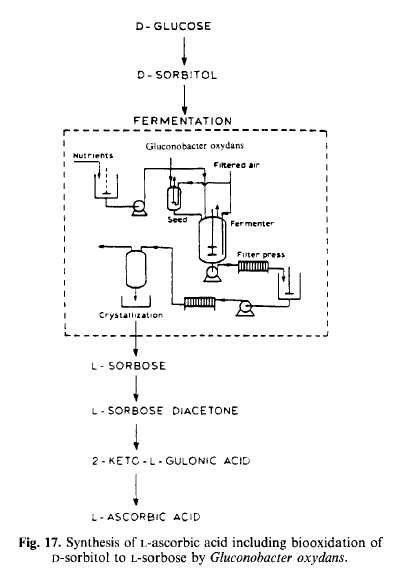
The thus obtained vitamin C may be further processed by purification andor separation steps. The current study presents the conceptual design of a chemical plant for an annual production of 500 tonne. VITAMIN C is first made from corn or wheat and then by action of heat and enzymesthey became D-glucose and then converted into D-Sorbitol and combined with oxidizedfermentation at the low.
The majority of ascorbic acid manufactured is used as an antioxidant. A well-known intermediate product is 2-keto-L-gulonic acid. Ascorbic acid Vitamin C is the most abundant natural hydro-soluble.
NutriFusion describes the manufacturing process for ascorbic acid from edible fruits and vegetables. VITAMIN C Ascorbic acid has two main routes of manufacturing processes. Process design and economic studies of two-step fermentation for production of ascorbic acid Abstract.
This is converted from starch to glucose by specialist companies and then to sorbitol. The manufacturing process that produces synthetically derived vitamin C leaves all the beneficial co-factors behind. This finished product is NOT VITAMIN C but legally can be called so which is very misleading to consumers.
The process is a complicated route that begins with D-glucose and has six major steps. One of them is the Reichstein Process developed in the 1930s from a Swiss chemist. Y_484 Production of Vitamin C Ascorbic Acid.
Here D-sorbitol is converted to L-ascorbic acid via 2-keto-L-gulonic acid 2KGA as key intermediate using a bio-oxidation with Gluconobacter oxydans and several chemical steps. Commercially ascorbic acid is mainly produced by a combination of synthetic organic steps and biotransformation.
All About Where Vitamin Supplements Come From Precision Nutrition

Biotechnological Approaches For L Ascorbic Acid Production Trends In Biotechnology

Biotechnological Approaches For L Ascorbic Acid Production Trends In Biotechnology
Vitamin C L Ascorbic Acid
