Polyvinyl acetate emulsion adhesive formulation and production process 710 kg of vinyl acetate Water 636 kg Vinyl alcohol Polyvinyl alcohol PVA 625kg Persulfate diluted 10 times with water 143 kg Octylphenol ethoxylates 8 kg 10-fold diluted with water 22 kg Dibutyl phthalate. Celanese is a global leader in polyvinyl acetate homopolymer emulsions often called PVAc or occasionally PVA homopolymers.

Polyvinyl Acetate An Overview Sciencedirect Topics
Vinyl acetate ethylene VAE emulsions are based on the copolymerization of vinyl acetate and ethylene in which the vinyl acetate content can range between 60 and 95 percent and the ethylene content ranges between 5 and 40 percent of the total formulation.
Polyvinyl acetate emulsion manufacturing process. PVAc emulsions are best known for their use in wood glues or school glues due to their strong adhesion properties. An emulsion is a very fine dispersion of one liquid in another with which it is immiscible. Acrylic emulsion manufacturing process XSM is a leading global manufacturer of crushing and milling Acrylic Emulsion PlantPVA Emulsion PlantEmulsion.
This results in the formation of a polyvinyl acetate emulsion that is milky white in color. Nitchen Chemicals adopt Vinyl Acetate Homo-polymerization methord to make Polyvinyl Acetate PVAC resin. Vinyl Acetate Monomer Capacity Production and Operating Rate 3-1.
The production of redispersible polymer powder is mainly divided into two steps namely emulsion polymerization and drying as shown in the figure. The process contains a series professional operations as follows. Google has not performed a legal analysis and makes no representation as to the accuracy of the status listed Expired - Lifetime Application number Inventor Marcel Bouchard.
Report provides a comprehensive analysis from industry covering detailed reporting and evaluates the position of the industry by providing insights to the SWOT analysis of the industry. Comprehensive analysis from industry covering detailed reporting and evaluates the position of the industry by providing insights to the SWOT analysis of the industry. PVAc is most widely used as an emulsion of PVAc polymers in water.
Detailed Project Report DPR on poly vinyl acetate Present Market Position and Expected Future Demand Technology Manufacturing Process Investment Opportunity Plant Economics and Project Financials. An emulsion is a system containing two liquid phases one of which is dispersed as globules in the other. Welcome to Frigmaires Engineers.
METHOD FOR MAKING A POLYVINYL ACETATE EMULSION OF HIGH SOLIDS CONTENT AND THE RESULTING EMULSION BACKGROUND OF THE INVENTION This invention relates to a method for making aqueous emulsions of. The emulsion is white to off-white in color and is the familiar white glue used in many household projects. Polyvinyl acetate is synthesized by the emulsion polymerization of vinyl acetate monomer VAM.
Impurities found in the reaction. An industrial polymerization process for the production of polyvinyl alcohol stabilized polyvinylacetate dispersions has been examined to investigate the influence of the start-up temperature on production process and latex characteristics. 71 Polyvinyl Acetate by Emulsion Polymerization Process Flow Diagram E-13 - vii - TABLES 21 Vinyl Acetate Manufacturing Cost Summary 2-5 22 Polyvinyl Acetate Manufacturing Cost Summary 2-6 31 US.
POLYVINYL ACETATE EMULSION PVA- FOR PAINTS PRODUCTION CODE NO. Manufacturing process for poly vinyl acetate in wikipedia Polyvinyl butyral - Wikipedia the free encyclopedia It is prepared from polyvinyl alcohol by reaction with butyraldehyde. Polyvinyl acetate emulsion pva- for paints production The project report includes Present Market Position and Expected Future Demand Market Size Statistics Trends SWOT Analysis and Forecasts.
The monomers VAC react in the tank to form the polyvinyl acetate. Polyvinyl acetate thus obtained was saponified by a. Manufacturing Process The processes involved in The resulting acrylic emulsion polymers are pumped.
Polyvinyl acetate PVAc is basically manufactured in water dispersible form The process involves the reaction of monomer molecules of vinyl acetate by submerging them into water. The emulsion is formed by polymerization in water of vinyl monomers predominantly vinyl acetate a process known as emulsion polymerization. Pva emulsion manufacturing process villasovaggioit.
Emulsion polymerization polyvinyl acetate emulsifier vinyl acetate Prior art date 1967-03-04 Legal status The legal status is an assumption and is not a legal conclusion. Currently the manufacturing process most widely used to produce vinyl acetate is the vapor phase ethylene process an oxidative reaction in which ethylene is bubbled through acetic acid at 120C in the presence of palladium chloride catalyst Daniels 1983. 015 part of ammonium persulfate were polymerized in emulsion at the temperature of 60 C.

Jinzong Machinery Chemical Resin Plant

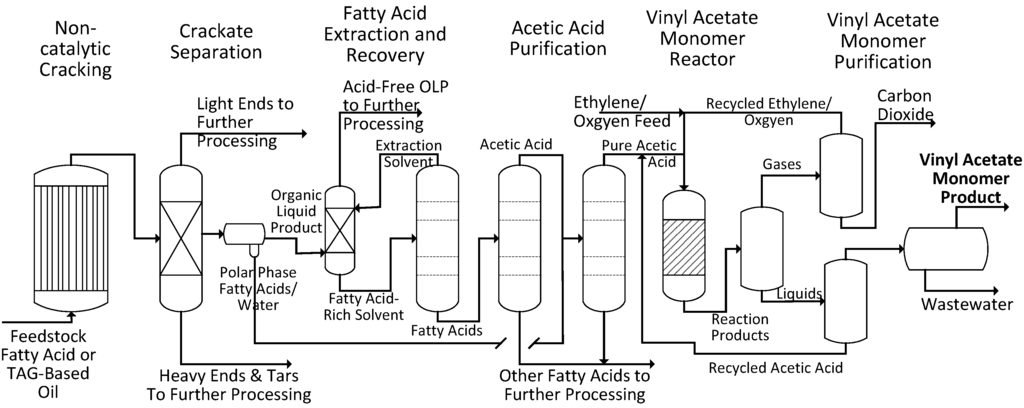
Processes Free Full Text The Production Of Vinyl Acetate Monomer As A Co Product From The Non Catalytic Cracking Of Soybean Oil Html
Processes Free Full Text The Production Of Vinyl Acetate Monomer As A Co Product From The Non Catalytic Cracking Of Soybean Oil Html

Pdf Preparation Of Poly Vinyl Alcohol From Local Raw Material
